Showing posts with label France. Show all posts

13.7.09

France 1968/ Iran 2009?


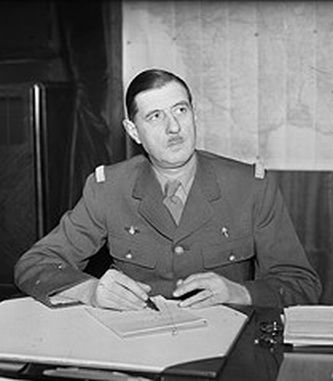
I was re-watching The Dreamers the other night. It is a film, as many of you are probably aware, set during the May 68 riots in France. What started off as localized student protests, spread through the whole country and threatened to topple the Gaullist hegemony. This of course electorally proved to be wrong, yet it is safe to say that despite not being toppled Gaullism certainly was shaken. The film shows symbols such as a tidy middle class girl’s bedroom, a kitchen table, a Delacroix painting, even a toothbrush being appropriated by the idylls of a Revolutionary youth, or at least disentangled from the General’s vision des choses.

Three things sprung to mind upon watching this film when considering the establishment which was being challenged. Firstly France at that period possessed nuclear capabilities. Secondly it was governed by a very conservative figurehead who acquired power in what can only really be called a coup. Thirdly the ideology which underpinned this movement was nationalist, souverainist and sought to redefine France along traditional lines with an emphasis on technological and economic betterment.

When we consider the protest movement it was defined as originating mainly from intellectual and student circles (emanating from the baby boom generation) escalating as time went on to the working classes. Then by its relatively short lifespan and then finally by its lack of structure and coherent leadership. That is to say that despite the various Maoist student organizations and la gauche spontex (as it was rather aptly called) and the trade unions, the fragmentation of ideology and leadership was evident for all to see. It was also defined by its lack of instant results (there was no revolution).

There are incredible similarities which can be drawn with what we saw recently develop in Iran. Obviously I do not have the pretence to assume that I understand the ins and outs of Iranian politics, but I feel I have a fair grasp and the comparison may be flawed in certain aspects (with regards to Iran’s nuclear program, its leadership and of course the rigging), but I feel that it certainly does bear some weight. Many of the descriptions of France's establishment and the protests in 1968 have a striking resemblance to modern day Iran.

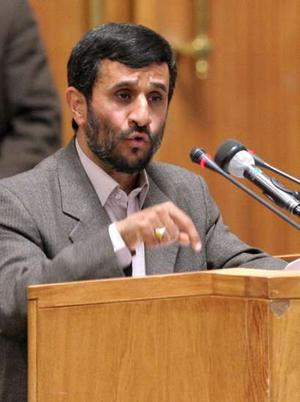
Both situations arose from public disapproval at an injustice/abuse of power and they also both represent a generational change in civil society’s approach to the individual and the role of the government's relation to said individual. They both escalated and were brutally repressed. The dust seems to have settled and it seems pretty clear that Ahmadinejad will remain in power, much in the same way that De Gaulle did.

It will be interesting to see the reverberations of this popular upheaval in the years to come. Despite the fact that De Gaulle remained in power for the following 2 years and that his dauphin became President after him, the foundations of the society which he sought to build and transform had been shaken and inescapably altered. Thus can we say that l’esprit de 68 which changed the way many people in France approached their leaders, and in fact themselves, will be present in Iran as l’esprit de 09 (if you will)?

Iran's leaders may have won the physical battle but it certainly lost the battle for the hearts and minds of the Iranian people (well most of them). It’s not so much about Mousavi not becoming President (he was not that much of a poster child for liberalism anyway), figureheads rarely capture the movement they represent, they merely ride it, it’s about what the protests represent and their reflection upon civil society. The vast underbelly of popular discontent which swelled in the streets of Tehran and other cities across the country will have to be dealt with. Considering the overwhelming youth of the movement and the loss of legitimacy of the Government and the Ayatollah, tear gas and snipers on rooftops will not quell such a societal demographic shift in attitudes and convictions. The appropriation of symbols such as the Azadi Square and the idea of Martyrdom with the murder of Neda Agha-Soltan further shows the potency of this movement.

Progressive change does not come quickly nor easily. That platitude is evident enough. But Governments faced with strong civil societies can only survive upon legitimacy whether by force of their argument or the force of their weapons. It remains to be seen whether the latter was enough, and I remain hopeful that, as in France, it was not.
17.9.08

PS: between Action and Denial


No one needs to be reminded of the sorry state of the PS in France. The loss of the Presidential election last year once again sent the party into the introspective mode which has dogged it since MItterand left office in 1995. What can be done to save a party which is unable to stand it´s ground in front of one of the most muddled and moraly corrupt Governments of the Vth Republique? Not much since it seems that little clear ideological direction has been seen since the Jospin administration, and little leadership since the loss of the Presidentials in 1995. The most striking example of this was the last election, which showed more clearly then ever the constraints placed upon Segolene Royal as she stood for President and the problems with the left in France. The problems which the PS faces are three fold, on the level of the party (both in structure and conjuncture), on the national level, especially in the context of being in opposition to Nicolas Sarkozy and on a ideological level (as the party seems to have fallen to the general marasme of the center left Parties within Europe).

LEADERSHIP CRISIS

One big issue is leadership, as any party which seeks to lead the country needs a leader, this much is clear. This the PS seems incapable of doing. Even during the Jospin years, he had Martine Aubry and Francois Hollande tugging for creative control like high school students in some newly formed band. The same for Segolene Royal, who had to contend with the ever more entrenched Elephants du PS. The party splinters itself into different factions, forming short lived coalitions with one another, while plotting the downfall of rival coalitions. To become leader you have to put yourself forward to contend with les Fabiusards, les Delanoistes, Les Royalistes (funny coincidence, no?), and so on and so forth with each prominent member of the Party. Each one incapable of imposing him/herself in case he or she gets kicked out of the band as it were. Some say this is due to the void left by Mitterand, since he was leader for such a long time. But for god´s sake that was 14 years ago! It´s a rather cheap excuse to hide the fact that the party has too many bloated egos at the same time, while the old guard seem incapable of accepting fresh blood such as Hamond or Royal (who are either ignored or derided). This is further worsened by the actual structure of the party. For example there is no official opposition leader in Parliament or in the Party. Even more confounding is that the General Secretary for example is not the candidate for the next election. You cannot have two imposing personalities at the head of a Party, it simply does not work. As the last election showed it can even destroy a marriage (Royal/Hollande). The party clearly has too many personalities bobbing around clawing for political influence and stature, while the structure is repellent to any form of functional hierarchy.

THE BAYROU AND SARKO EFFECT

The PS does not offer an credible alternative to the currrent administration, yet it seems even incapable of fronting a credible opposition to Sarkozy. This is in part due to it´s incapacity to find a clear leader and message, but also there are Sarkozy and Bayrou to contend with.
You know the left in France is in trouble when a former member of the ruling party is providing the main opposition to Sarkozy. Though Bayrou and his center party (the MOdem) seem to epitomise more a Gaullist resistance, then a center left one. Not only that but Bayrou hopes to form a coalition with the PS at the next election (only Royal seems to have warmed to that idea). He was even invited, half jokingly half seriously, to form une motion for the next Party Convention in November. He is capable of fronting an opposition to Sarkozy, in light of his imposing presence within his party (though the fact that his party is largely his creation does help), and the vaccum left by the introverted PS.
Sarkozy also has managed to blur ideological lines to such an extent and fire highly symbolic yet minimaly important legislation (to appear at once as the trend setter but also as the reformer) that the PS simply does not know how to react. A good example of this was the creation of the RSA, which is a more effective substitute for the RMI. It would have been a perfect opprtunity to call out in unity and agree with the content, but disagree with the way it was financed (since the middle class will have to shoulder most of the burden, as opposed to the rich who are protected by a fiscal shield). The party would have presented itself as a coherent and cooperable opposition, while disagreeing with Sarkozy´s economic policies. Instead we got nothing. Nor does it help that this is traditional left wing territory, but Sarkozy is an expert at reaching to both sides of the political spectrum. The effect is worsened by the poaching of high flying former members of the left such as Kouchner and Hirsch. While the constant atmosphere of debate within the UMP, and still being able to maintain a clear leadership (as seen with Edvige) can only but weaken external opposition in the public eye.
The PS is incapable of fronting an opposition to Sarkozy, even in the light of some truly contemptible behaviour (Corsica, need i say more) and worrying legislation (Edvige for one). This is not helped by Bayrou, who benefitting from a small and operational party, has managed to provide a revival of the center in France, while spliting the party over the idea of an alliance.


LEFT WITHOUT A COMPASS

Yet this weakness is reflective of the lull in which most of the center left European Parties find themselves. The situation in Germany is very similar. With the SDP incapable of deciding wether to stay firmly on the left or move towards the center (it seems to have decided the latter for the forthcoming elections), while slowly it´s electorate is eroded by Die Linke on it´s left and the CDU from it´s center. The same can be said with the French Socialists. They are uncertain which way to turn. Whether to consolidate themselves with their base (as Aubry and Fabius clearly favour) so as to eat away at the 10-12% who voted for leftist extremists parties such as the LO or the PCF in 2007. Or whether to move to the center to either ally themselves with or engulf the Modem and the center (as Royal and Delanoe clearly favour). This trend is increasingly obvious throughout the whole of Europe. It´s visible in the failing left wing governments of the UK and Spain, and in the failings of recent elections in Italy and Germany, while it is painfully clear in France.


The PS needs to sort out the structure of it´s party. Favouring clear and established opposition: such as a the creation of a formal speaker in the Assembly and combining the posts of General Secretary and Presidential Candidate. This would impose a leader who can succesfully occupy the spectrum and present itself as opposition, while going some way to silence dissention within it´s ranks. I think an alliance with the Modem would be counter productive, since the party can simply move towards the centre and eat away at the Bayrou electorate, instead of relying on the man himself (who cannot be trusted). In very much the same way Sarkozy did with the UDF last year. Not moving towards the center would be stupid and short sighted since, the harder left will always vote for the lesser of two evils au second tour and that will always be the PS over UMP. As for the ideological move there are no easy answers, but drawing on the examples of Blair and Zapatero, I think would be a good start. That, twinned with the ideas put forward for the creation of a participatory democracy (cf Segolene Royal), would put the party at the forefront of innovative politics in a France already tired of (but at the moment resigned to) Sarkozy.

8.5.08

Who's left?


"Quand les hommes ne peuvent plus changer les choses, ils changent les mots."
Jean Jaurès

A year on from their loss to Sarkozy and 6 years from their loss to Le Pen, the PS has not been able to go beyond it's largely uncomfortable and disjointed Gauche Plurielle, the left cause isn't stuck in 1968 it's stuck in 1982. The Socialist in the Socialist Party became redundant the moment Mitterant admitted the failure of his Statist economic policy in 1981, since then it has been relying on it's own dwindling electoral base and the imposing personality of it's leader, that and a divided RPR. Ever since the end of the Mitterand years, the left seems unable to move on and challenge it's principles, and it's electoral success (if any) has more to do with the failures of it's opponents (Sarkozy and Chirac) then the actual popularity of their policies and their visions.

That's not to say that Jospin or Royal were not appealing to the French Electorate, but the dissatisfaction with the Party was evident in 1995 and 2002, with the trickling away of votes to the extremes, as was it's redundancy in 2007, considering the Campaign wasn't really a movement for change, more one against change with a pretty smile. If one were to look at the actual election pledges and promises of the Socialist Manifestos of 2002 and 2007 they are largely the same, though one was called "le droit d'inventaire" and the other "Le Pacte Presidentiel" they only differed really in presentation and wording. Though the latter did stress the importance of knowing La Marseillaise and Flag Waving, one does wonder whether the party is stuck in some odd time warp.

The party has been promptly deserted by two of it's most promising and in my opinion Presidential Members: Bernard Kouchner and Dominique Strauss Kahn. The former, joining the Fillon Government upon it's election and subsequently being excluded from the Party, and the latter, being so embarrassed by the state of the Party and tired of it's seeming unwillingness (though clear need) for a social democratic revolution, has gone and joined the ranks of the IMF.

Other leading Socialists such as Francois Hollande and Martine Aubry have disappeared into the wilderness, not that they have much to offer anyway in terms of novelty and fresh thinking. So what are we left with? What's left? (I will stop with the bad puns soon, I promise) Well the factions seem to have risen and polarised since the fallout of last year's election which resulted in the lynching of failed candidate Royal by a party shamelessly unable to admit collective defeat.

The first we can identify, is the one which has always existed, the branch epitomised by Laurent Fabius, as former Prime Minister in the 80s, he's no spring chicken and neither are his ideas which are pretty much your standard socialist agenda. He represents the old administration of the Mitterand years and what some would qualify the comfort zone of the Party.Bertrand Delanoë (the recently re-elected Mayor of Paris) and Segolene Royal are sparring on similar territory, both trying to bring the Party more to the centre, both claiming to represent the third way for the Party. Their approach differs more in tactic then actual ideology, as Segolene Royal intends to forge an alliance with the centre party Modem, while Delanoë prefers to foster change within the party itself.

While to some this might seem like the burgeoning of a direction for the party, the dust has yet to be stirred, as they all may talk of change or renewed outreach, but their words mean little since no new ideas are coming to the fore and the debate within the party is very stale. After all talk of change has been going on since 1995 by roughly the same people.

The recent blues of the Sarkozy administration has given the Party a boost in support which has once again delayed the perceived need for change, and encouraged that dreadful spirit of nostalgia for their Golden Age and their subsequent apathy. The leaders of the Party are all too busy with their own self promotion to bother trying to unify the party, while other party elders are scared to interfere for fear that the party will tear itself to pieces and split.

Hollande needs to be more open to debate and start trying to reforge the identity of the party instead of idly watching the Punch and Judy show which is the forefront of Socialist politics today. They also need to start challenging the Government, that is to say not only defining themselves as opposition but as credible opposition. With the death of the centre which has been incorporated into the UMP (UDF) or failed miserably (Modem) and the current dissatisfaction with Sarkozy gives the party an opportunity to fill in the gap and set the tone of the political debate.

Reforming the Secu to become income assessed, or the liberalisation of Universities, the end of weapons manufacturing and selling to Third World Countries, an end to the witch hunt for the Sans Papiers, a specialisation of Secondary education or the rationalisation of medical reimbursements... there are so many notions and values inherent to the left which can be translated into the modern post industrial consensus.Though I'm mainly basing myself on some of DSK's ideas, there is hope for the resurgence of a more effective and pragmatic left in France which doesn't need to become the burnt out husk New Labour is today, but at the moment very little.

It's not a good time to be a Socialist in France.

14.3.08

Rear View Mirror

Hindsight is an odd thing. I found these rather overly emphatic scribbles nearly a year after the Presidential Election in 2007. The first one was written before le premier tour and the second a l'entre deux tours.


The case for Segolene Royal... (21rst April 2007)

Though I may not have the right to vote in this upcoming election, I have through much deliberation come to the conclusion that France should vote Segolene Royal this Sunday and in the second round. I have come to this conclusion for three main reasons: firstly, her consistent programme, her accessibility,and thirdly, she is the only one capable of beating Sarkozy.

Throughout her whole campaign she has retained a consistent line in her programme, though sometimes tinted by odd populism (which is inherent to being a politician) such as all the french should learn la Marseillaise and brandishing French flags. She is not however prone to outbursts of machoism and one-upmanship which characterises the election trails of karcher brandishing Sarkozy or the "virile" Bayrou. She has kept a strong modern socialist programme which is much more palatable then the vacuum of Bayrou (who doesn't know his right from his left) or the liberal-dirigiste-multiculturaliste-nationaliste muddled promises of the candidat UMP.
She may not be a fantastic orateur but one thing she does have is an interaction with the people which Sarkozy (who hasn't stepped anywhere remotely banlieux since the riots) or Bayrou could only dream of... To put it simply she hasn't cut herself off from a whole part of the French population. She has the capacity to debate with people which is at once refreshing and bold since her programme is a systhesis of the wishes of the french people (from all backgrounds and origines). She has been criticized many a time for a lack of consistency but in the last month she has turned up trumps proposing a very concrete programme and a vision of France which is at once forward looking and pragmatic. She hasn't got the arrogance of Bayroux or Sarkozy who assume that their ideas are the ones the french need, she has made herself open to debate and rid herself of the shackles of the French socialist party ideology, while allying herself with intelligent and strong men of the left such a Strauss-Kahn. People say she hasn't revolutionised the Socialist party into a "nouveau party socialist" but as I said before she is not constrained by the party and to add to it, the French left once in power seem to be a lot more pragmatic then the right.

Finally France needs Segolene Royal because Sarkozy is dangerous and she is the only one who can beat him. Anti-Sarkozysme has become a past time in France for a whole part of the population, no other man in French history has been so popular and yet so loathed. He has many assets, but his authoritarian nature ("misnistre de l'identite nationale et de l'immigration" for one) and lack of communication beyond police shields and angry words to a whole half of the french population, makes the prospect of a Sarkozy presidency unthinkable. A president should be capable of communicating to the whole French people, he doesn't have that capacity nor does he wish to. She has the depth and strength to beat him, unlike Bayrou who is as Le Pen so correctly put it a "bulle sondagiere".
She has many faults and she is in no means representative of all my beliefs but she appears to be the best and the only one who won't sink France lower then it has already sunk, and who offers a real alternative to Gaullism which has cursed France since the great man was president himself.In conclusion France needs her.


The end of one man's dream and a nation's nightmare? (26th of April 2007)

From the day the results were shown everybody said Sarkozy will win hands down. With a historically high score nothing seems capable to stop this man from holding the keys to the coveted Elysee Palace. Segolene Royal, though she herself receiving a high score in the first round, has been told many a time that she will not be able to "rassemble" around her a sufficient amount of people to beat Sarko on the 7th of May. With an electoral base of around 40% the left in France has never had a tougher challenge. All the sondages gave Sarkozy a hands down victory against Royal ranging between 55-45 or 53-47 in favour of Sarko.

Things now however do not seem so sure with the results of a recent poll showing the gap between the two becoming smaller (49-51 in favour of Sarkozy). This slide coming from the sudden surge in optimism of a reinvigorated left throwing away the dark shadow of 2002 and combating more fervently against the negative and populist election slogans of a politically muddled Sarkozy, who finds it normal to quote Jaures and Blum in his speeches, when he knows nothing of the words compassion, humanity and dialogue.

Madame Royal is also gaining ground on the electorate of M. Bayrou. Unlike Sarkozy, she is perceived as a more centrist candidate. To add to this the manner in which she wishes to woo the UDF electorate is one of discussion and debate, unlike M.Sarkozy's threats and masochist flexing of political muscle, which shows clearly the different ways in which the Presidential hopefuls wish to govern France in the future. One can therefore understand why the Bayrou electorate is expected to vote in favour of Royal.

The election day is looming closer and closer, France will have to make a choice between two visions of the future. One in which intolerance, violence, "false promises" and "deception" (as Sarkozy said himself about the post election period), reign or one in which compromise, dialogue and hope will be King (pun not intended). The choice is clear.


28.5.07

Being anti-Sarkozy is not enough.


The moment Segolene Royal uttered the words "I wish the next President of France to..." my heart sank. What I already knew had happened, all I had hoped destroyed. I thought France knew better, I was wrong, but at the same time I knew that it couldn't have happened any other way. Now as M. Hortefeux pays immigrant families to leave France, Le Pen inspired ministries pop up and the European door smashes firmly shut on Turkey, the left in France has never faced a tougher internal and external challenge. The left must act now or face extinction.

ELECTORAL DEFEATS

The French socialist Party has not won a Presidential election since 1988 and after losing to the right wing Nicolas sarkozy a few weeks ago, they are likely to receive another bloody nose in the parliamentry elections this july. This twinned with the deep introspection and subsequent paralysis after the humiliating defeat of Lionel Jospin in april 2002 by the National Front candidate Jean Marie Le Pen, makes the future of the party look bleak. Some have blamed the latest shortcomings on a lack of ideological modernity within the party, a failure to grasp the new challenges which face our society and an unwillingness to accept that socialism died in 1991. Others on the other hand fear the party has lost it's electoral base, that it isn't looking out for the "little guy" which explains the trickling away of votes to the extremes and that it has betrayed the values and principles of the traditional left. These two currents within the party threaten to split it in half, one half defering to the center and the rest swinging the party to the left and crossing a political desert similar to that of Labour party under Micheal Foot.

CONSTRAINED BELIEFS AND INEXPERIENCE

Segolene Royal who mainly presented herself as the anti-sarkozy candidate during the election, contrasted strongly with a Sarkozy who seemed to draw strengh from a wide base of contrasting personalities and a strong backing from his party, advantages which Royal did not benefit from. The sheer strengh of a reinvigorated right wing with an incredibly controversial yet popular and hard talking leader, intimidated a damaged and unsure party with a inexperienced leader whose real social democratic beliefs were constrained by the very people who chose her.
She was laughed at for proposing to heavily sanction criminal youths by military training and for praising Tony Blair's economic and political record. From the very start she was given no leway for imposing her beliefs and was forced to present an old style socialist agenda with a tinge of social authoritairianism to pander to the extreme right, with hindsight it was a tragic and comical farce.

HUMILIATION AND DESERTION

Nicolas Sarkozy's appointment of Bernard Kouchner, a leading member of the socialist party, as minister for foreign affairs, was the coup de grace in splitting the french left. Though the post is devoid of much responsability, because it is the domain of the President and his advisor (Jean David Levitte, a famed atlantist), M. Kouchner's acceptance of the post was a huge blow to the center left cause. The vilification of the Sarkozy camp and the subsequent "desertion" by a leading social democrat to the Fillon Government, will paralyse the center of the party as they will be presented as pragmatists and moraly corrupt. So Strauss-Kahn's calls for an "effective, credible and concrete left", along with Royal's calls for the left to "rise above the old battlefields of the left", in effect calling for the socialist party to follow the third way, will fall on deaf ears. Former Prime Minister and disciple of Mitterand: Laurent Fabius cries for a left "to be proud of being anchored in the left" will appeal more to the defensive and humiliated party members.

THE LAST STAND

If the party falls into the hands of Laurent Fabius, the internal feuds continue and the social democrats do not rally together, the party will vanish. The 2007 election presented itself as the last stand of the old Socialist party, it now has an oppotunity to shake away the shakles of Mai 68, and renew itself by accepting change, real change. It must accept that the 35 hour week is an absurd piece of legislation, it must realise that the state and taxes are not the solution to everything. However it must continue in its fight to preserve France's internationaly renound services, to defend civil rights against the dangerously authoritairian nature of Sarkozy's social policies and most importantly it most continue European integration (including Turkey).
The new socialist party must be proud of its convictions and strong enough to bring its fight to new levels, or tomorrow we will mourn the death of the left in France. Being against something does not define you, nor do old hat ideas, dynamism and conviction define you. Today only Sarkozy seems to posess those qualities.