Showing posts with label Nationalism. Show all posts

5.9.09

Debating the BNP


According to the mainstream parties of British Politics the main reason for not discussing anything with the BNP publicly (ie. on weekly platitude fest Question Time or the Daily Politics) is that it gives them a higher profile and legitimises them in the eyes of the wider public. The recent decision to review long-standing Labour Policy of no debate with the BNP is being discussed by Labour Party big-wigs in light of Nick Griffin's invitation as a panellist on QT and the BNP's success at the last European Elections.
It seems that since the last time they looked the BNP now has access to many more funds and an elevated media profile. They are now wondering whether or not they should acknowledge this and go face to face with regular James Blunt and bullshitter Nick Griffin MEP and his circus troupe of performing baboons (no offence to baboons).


I'm not going to do one of these posts about how awful it is that the Blackcoats are Haw Hawing in their cornflakes (witty) at the recent news of their election in a vote which meant nothing to anyone in a parliament which means nothing to anyone. I don't like the BNP, neither do you (most likely), let's move on.


It simply astounds me that so many in the mainstream of British Politics refuse to debate with them. While some in the ranks of the moderate even go so far as to say we should ban them. A combination of ignoring the problem until it goes away and banning/not taking into account those who don't agree with you smacks of the 5 year year old with his hands on his ears shouting LA LA LA at the top of his lungs until the problem decides to sort itself out.

Ask a Frenchman/woman to tell you the effects of ignoring a fringe party and he/she will cite the 2002 Presidential election in which National Front came second in the first round. Ask any Italian or German to tell you the effects of banning a fringe party and she/he will cite the terrorism engendered as a result. Suffice to say history should have corrected the silly illusion that we should ignore/ban the party.

Then why do the mainstream do this? What makes them spout inanities which amount to saying if you wish to debate with me you have to agree with me on this, this and this? Yes the BNP are wrong about race, yes they are wrong about Europe and so on and so bloody forth, but in my eyes the Conservatives are wrong on pretty much everything, why don't we ban the Conservative Party? Should you not be confident/secure enough in the strength of liberal democracy and pluralism that you can defend it against such idiocy?

You can only uphold liberal and pluralist democracy if you let it harbour its antagonists, or at least let them speak. Same goes for radical Imams and Revolutionary Marxists. Something Voltaire said about mildly inconveniencing himself for your right to speak and something else about God granting his wish that his enemies be made to look ridiculous spring to mind. These ideas go hand in hand. If you let them speak, it amounts to them giving you the stick to beat them with. That's the beauty of the system these shy democrats/pluralists represent, they just seem to have forgotten that.

Upon the news that the BNP were elected to the European Parliament the Conservative Party announced that it was glad that we don't have a system of Proportional Representation in Westminster. So they justify an unjust and outdated voting system by saying that it stops the BNP being elected to Parliament. It's not as if we would end up with the instability and centrifugal forces of the Weimar Republic, many of the French Republics or Post-War Italy should we finally be given an opportunity to cast a FAIR and CONSEQUENTIAL vote. I'd rather not be talked to like a moron when in fact it's obvious the Tories simply don't want to change a system which advantages them.

But it's not only the Tories being pathetic about this. Labour have gone from bad to worse. Not only have they dropped plans for PR but they recently proposed (to the delight of the BNP) new legislation to prioritise locals in the council flat selection process based on a MYTH propagated by the BNP itself. Also their near silence on Europe has been infuriating and has played right into UKIP's and the BNP's hands.

Another problem in not addressing the problem of the BNP is that it makes it impossible to acknowledge the isolation felt by many disaffected voters in the outskirts of London and the North of England from the political system. Thus their needs are not taken into account and their misconceptions not addressed. Which is certainly not healthy, nor is it fair.


The problem is that if the mainstream continues in its policy of simply ignoring the BNP and using it as a smokescreen for their own incompetence and lack of imaginative and forward looking policy, the BNP can only flourish as the party of change, albeit regressive unchallenged change.

15.6.08

LisbOFF


The Irish Vote last week was the only referendum to be held in all of the 27 countries of the EU as to whether or not the Lisbon treaty should be adopted. The fate of one of the most important and innovative texts of the European Union was left in the hands of a nation of around 6 million people (representative of just around 1% of the EU population), and the treaty was rejected by 53.4% to 46.6%. Mostly because voters were uncertain about what the treaty actually meant and what it stood for. Declan Ganley head of minority party Libertas was heard on Saturday heralding the defeat of the treaty as a slap in the face of much reviled Eurocrats. He went on to say "This is democracy in action... and Europe needs to listen to the voice of the people". This is reflective of mainly three things: the ignorance of the population at large as to the objectives of the European Union and the Lisbon treaty, the distorted and infuriating diatribes of the right wing/nationalist forces as well as the dangerously passé and archaic mechanisms of European Politics.

It's important to remember that the actual vote in Ireland was meant to be an easy thing, most were more worried about the Treaty not being passed in the UK's upper House, or even in the Spanish Congress. But no one was really worried about the Irish referendum until a few bothersome polls showed the no camp gaining ground about a week or so ago. And then again there only were faint worried whispers within the international press and the hallways of the European Parliament two days before the actual vote.
So should we be worried that a State like Ireland, which has established fairly strong European credentials, has rejected the treaty? I don't think so, because firstly the turnout was very low indeed with only 53.1% turning up at the polls and secondly most voted "no" because they did not understand the actual text and thought it might affect issues such as abortion. That in itself is not an anti-Europe vote, but more a pathetic squeal of nationalism galvanising a backdrop of apathy and uncertainty.
How could such voters be so ill informed? After all there is a wealth of articles and numbingly simple "the Lisbon Treaty explained" 10 point summaries available so easily on the internet and in the media. It seems so mind bogglingly odd that no one knows what it's about. In fact it seems to me that most hide behind the length the Treaty to mask their laziness and ignorance, but that's my angry defeated opinion. A more pondered approach however would show that, in fact, as well as being slightly lazy, the population were mostly fed these Soviet/Evil Empire/EU Comparisons ad nauseam (apparently Barosso is the new Stalin)by a frighteningly biased media, who happily dispense of fact for opinion, while the more liberal press and the prominent proponents of the treaty kept quiet, for some odd reason or other (most probably arrogance). The information out there was unlikely to swing it in favour of the the "Yes" vote.

It's not so much the Irish "No" which makes a Europhile's blood boil, but the snide look of victory on the faces of the "no" camp, which make for a sickening spectacle. Declan Ganley (Libertas) was not the only smug half wit celebrating in Dublin on Friday, but his speech was particularly poignant. In that he said this was a victory for democracy and the people of Ireland. He went on to say that he wanted a collective of nations, not some Federal State administered by a number of Belgians and Germans, using some overly convoluted and undemocratic text to undermine national sovereignty and democracy (see summaries are not that hard).
What he seems completely incapable of realising is that should the treaty have been passed, largely undemocratic areas of the actual European Union would have been sorted out. With for example the creation of a more visible and accountable figurehead, a parliament with greater jurisdiction, greater powers to European Courts, not to mention a more prominent role on the world stage (something which Ireland could only dream of), and so on. So by opposing such measures, he is leaving the EU in flux more then anything, still undemocratic and with no significant progress made.
Another thing he said was that the text was too long. But I guess that would be normal because a man of such simplistic reasoning simply cannot even begin to process the difficulties and the vast tasks/undertakings which the EU has to deal with. Hence the need for a developed and pluralistic bureaucracy to cope with such demands. While at the same time it has to deal with being tugged at on all sides, by these pathetic nationalisms, which in fact create more opt outs and exceptions, clauses and fine detail. People overlook the fact that that in itself MAKES THE TREATY MUCH LONGER AND MORE DIFFICULT TO UNDERSTAND. One of the main reasons it has become so complicated is because morons like the head of Libertas make it so.
One last argument is this idea that somehow countries have not benefited from European integration. In all of the three pillars of the EU, the Union helped innovate, create and rationalise many areas in which European countries (especially Ireland which has benefited much more then most) were lagging behind and are now able to compete on the world stage. Without the stability and economic prosperity which the European Union has given us, the values of Democracy and Freedom which so many within the "No" camp claim to be defending would simply not exist. Though of course it has not been perfect and the Union has not solved all national problems, it is undeniable that it has been a huge and indispensable asset to us all and still has a lot to offer.


However it is easy to sit back and blame ignorance and others for the recent failings of the EU. Blame lies strongly with the Europhiles and the way European Politics is conducted. Brown and Cowen should have stood up and explained the treaty in detail and not avoided all questions. When they don't, it gives the impression that the transparency of the European Union is very limited and is likely to continue to be, once more power seeps into the European Parliament and Council. Thanks to them and the apparent rejection of democracy (though last time I checked national congress was elected, but hey...)by not having referendums, Brussels has never seemed more detached from the streets of Belfast, Dresden and The Hague, and never has it seemed so self serving. No wonder they rejected it. I'm not protesting at the lack of referendums (I don't believe in them), but a lack of discourse is dishonest and disheartening, not to mention defeatist. It's like saying "I know what's best for you and for us, but I'm not going to tell you because you won't understand". This kind of patronising behaviour by the Governing Class shows a dangerous lack of belief in the principles of democracy and overlooks the good which can come from of an informed and intelligible public debate.

Should we have more pro-active European MEPs and supporters on the forefront of politics today this problem would not have presented itself. The EU needs to be more honest and open, it needs to challenge and defend as opposed to hide and litigate, it needs to assuage fears, not encourage them. The Lisbon Treaty will pass, as did it's predecessors even when they were rejected a first time, but that does not mean that the EU can continue the way it is. Otherwise I fear the worst, there is nothing more scary then a nationalist backlash.

7.5.08

Failed Leader of a Divided Kingdom:


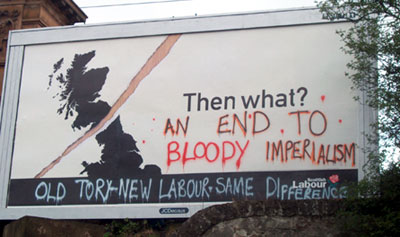
Amid wide speculation as to whether Brown will win the next elections in 2010, I think the more interesting question is whether he’ll make them. Not because of some backbencher rebellion, embarrassing commons defeat or the possible announcement of leadership ambitions by John Denham or David Miliband, but because of the end of the British Union which has existed since 1707. Wendy Alexander, head of Scottish Labour, has made a U-Turn which would even make Harriet Harman blush. She has announced after months of deriding the idea and arguing against it, that she wants a referendum on Scottish independence. This is likely to happen in 2010 that is to say at the next General Election. The MP for Kirkcaldy and Cowdenbeath may find himself unable to stand for the leadership of this Country, since it would simply cease to exist. Now, not only does he need to guarantee that his party will let him stand again, after the dire electoral performance last week and the humiliating loss of London to a buffoon, but he also needs to keep the country together.


Gordon Brown has known about the resurgence of Scottish Nationalism and the threat it represents to his leadership for a long time. This is why he can often be heard mumbling something about Britishness and his British Patriotism, not to mention the creation of a Britain Day. While most chuckle gently at this rather misplaced and slightly American form of Flag waving, Gordon Brown’s career and future as Prime Minister depend on it.However as with most of Brown’s vision and ambitions for the Country, it has not translated into a reality and the UK has never been so fragmented and divided.


That’s not to say that Alex Salmond is standing on some Hill, armed with sword and shield announcing the Freedom of his people, as a fatter and uglier version of Mel Gibson. However the ascension of a minority nationalist government in Edinburgh ,regardless of then Chancellor of the Exchequer and soon to be Prime Minister Gordon Brown, in may 2007, was a clear sign that Scots were not satisfied with the efforts of devolution under Blair and Brown. The loss of support Labour suffered in the 2007 elections was also down to the War in Iraq and Trident. The grip the Labour Party has upon Edinburgh and Scottish politics has been on the wane since its peak in 1998 after the Scotland Act. Membership to the party in Scotland has just about halved since Blair took office. It also has a weak position in Parliament due to it’s relegation to 2nd place, behind the resurgent SNP and is suffering from the collapse of it’s coalition with the Liberal Democrats. Brown’s grip upon Scotland has further weakened.

This was twinned with a rise in nationalism mostly because of a sense of economic independence due to the recent hike in oil revenue and the recent prosperity of the Economy. Add to this a Scottish Government, though a minority one, intent on defending Scottish interests and expanding it’s jurisdiction over certain matters: the Nationalist agenda has never been so alive.


The most interesting rift however is within the usually well whipped (forgive the expression) Labour Party. Wendy Alexander went against the direct orders of Gordon Brown in announcing a Party U-Turn on the idea of a referendum. Her intention was to deflect attention from the recent funding scandals within the party and finally put the issue of independence to rest, while at the same time distancing herself from the increasingly and depressingly unpopular Brown, which might give Scottish Labour a boost.


A seemingly more cooperative Unionist Labour could assuage the mounting support for independence. Recent polls suggest that support for independence is rising but still on slightly lower then opposition to it, which means Labour can still counter this trend. Brown’s plans for the creation of a regional Senate (similar to the Bundesrat) in the place of the House of Lords, introduces an element of Federalism which could satisfy a number of Nationalists. This on a backdrop of greater constitutional protection as European Integration intensifies and ideas for a bill of Rights become more concrete, both of which will naturally boost Scottish independence from the National Executive. Gordon Brown should also devolve more power in fiscal and welfare regulation to Edinburgh. These possible reforms could keep the prospect of a united kingdom and Gordon Brown’s Leadership alive.

The implications for Brown are great, that is to say that a lot is riding on the next election, and that the Labour Party might not want to risk going into it with Brown as leader considering his rather spectacular loss of support and the possibility of Scottish independence. His baggage might be too much for some within the Party to stomach. Blood is most likely to be spilt should Brown continue to fumble around and make a complete hash of his premiership (which seems quite likely). This of course is being played up by Cameron who now unfortunately speaks for most of England, and benefits from this peculiar phenomenon by protesting about the redistribution of wealth between England and Scotland and the right Scottish MPs have to vote on English matters (the West Lothian Question). The Conservative Party is not really interested in the preservation of the Union as it would be a decisive blow to Labour should Scotland secede from the UK and, thus increasing their grip on Westminster(since they are absent in Scotland)

Personally I think he and Harman should be given the boot (he has become far too much of a liability now) and John Denham step up to the challenge. Unfortunately not many miracles happen in British politics and we are likely to see a long, drawn out and painful end to Brown’s career as we all stand back in shock at how wrong we were about him. If he doesn't act now, his legacy is going to be an divided nation, a crushed Labour Party and another 20 years of Tory government.