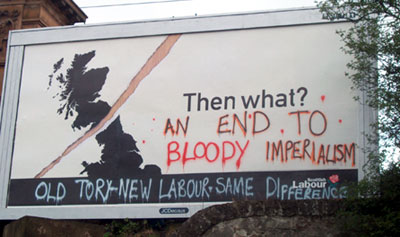
Showing posts with label Brown. Show all posts

7.5.08

Failed Leader of a Divided Kingdom:


Amid wide speculation as to whether Brown will win the next elections in 2010, I think the more interesting question is whether he’ll make them. Not because of some backbencher rebellion, embarrassing commons defeat or the possible announcement of leadership ambitions by John Denham or David Miliband, but because of the end of the British Union which has existed since 1707. Wendy Alexander, head of Scottish Labour, has made a U-Turn which would even make Harriet Harman blush. She has announced after months of deriding the idea and arguing against it, that she wants a referendum on Scottish independence. This is likely to happen in 2010 that is to say at the next General Election. The MP for Kirkcaldy and Cowdenbeath may find himself unable to stand for the leadership of this Country, since it would simply cease to exist. Now, not only does he need to guarantee that his party will let him stand again, after the dire electoral performance last week and the humiliating loss of London to a buffoon, but he also needs to keep the country together.


Gordon Brown has known about the resurgence of Scottish Nationalism and the threat it represents to his leadership for a long time. This is why he can often be heard mumbling something about Britishness and his British Patriotism, not to mention the creation of a Britain Day. While most chuckle gently at this rather misplaced and slightly American form of Flag waving, Gordon Brown’s career and future as Prime Minister depend on it.However as with most of Brown’s vision and ambitions for the Country, it has not translated into a reality and the UK has never been so fragmented and divided.


That’s not to say that Alex Salmond is standing on some Hill, armed with sword and shield announcing the Freedom of his people, as a fatter and uglier version of Mel Gibson. However the ascension of a minority nationalist government in Edinburgh ,regardless of then Chancellor of the Exchequer and soon to be Prime Minister Gordon Brown, in may 2007, was a clear sign that Scots were not satisfied with the efforts of devolution under Blair and Brown. The loss of support Labour suffered in the 2007 elections was also down to the War in Iraq and Trident. The grip the Labour Party has upon Edinburgh and Scottish politics has been on the wane since its peak in 1998 after the Scotland Act. Membership to the party in Scotland has just about halved since Blair took office. It also has a weak position in Parliament due to it’s relegation to 2nd place, behind the resurgent SNP and is suffering from the collapse of it’s coalition with the Liberal Democrats. Brown’s grip upon Scotland has further weakened.

This was twinned with a rise in nationalism mostly because of a sense of economic independence due to the recent hike in oil revenue and the recent prosperity of the Economy. Add to this a Scottish Government, though a minority one, intent on defending Scottish interests and expanding it’s jurisdiction over certain matters: the Nationalist agenda has never been so alive.


The most interesting rift however is within the usually well whipped (forgive the expression) Labour Party. Wendy Alexander went against the direct orders of Gordon Brown in announcing a Party U-Turn on the idea of a referendum. Her intention was to deflect attention from the recent funding scandals within the party and finally put the issue of independence to rest, while at the same time distancing herself from the increasingly and depressingly unpopular Brown, which might give Scottish Labour a boost.


A seemingly more cooperative Unionist Labour could assuage the mounting support for independence. Recent polls suggest that support for independence is rising but still on slightly lower then opposition to it, which means Labour can still counter this trend. Brown’s plans for the creation of a regional Senate (similar to the Bundesrat) in the place of the House of Lords, introduces an element of Federalism which could satisfy a number of Nationalists. This on a backdrop of greater constitutional protection as European Integration intensifies and ideas for a bill of Rights become more concrete, both of which will naturally boost Scottish independence from the National Executive. Gordon Brown should also devolve more power in fiscal and welfare regulation to Edinburgh. These possible reforms could keep the prospect of a united kingdom and Gordon Brown’s Leadership alive.

The implications for Brown are great, that is to say that a lot is riding on the next election, and that the Labour Party might not want to risk going into it with Brown as leader considering his rather spectacular loss of support and the possibility of Scottish independence. His baggage might be too much for some within the Party to stomach. Blood is most likely to be spilt should Brown continue to fumble around and make a complete hash of his premiership (which seems quite likely). This of course is being played up by Cameron who now unfortunately speaks for most of England, and benefits from this peculiar phenomenon by protesting about the redistribution of wealth between England and Scotland and the right Scottish MPs have to vote on English matters (the West Lothian Question). The Conservative Party is not really interested in the preservation of the Union as it would be a decisive blow to Labour should Scotland secede from the UK and, thus increasing their grip on Westminster(since they are absent in Scotland)

Personally I think he and Harman should be given the boot (he has become far too much of a liability now) and John Denham step up to the challenge. Unfortunately not many miracles happen in British politics and we are likely to see a long, drawn out and painful end to Brown’s career as we all stand back in shock at how wrong we were about him. If he doesn't act now, his legacy is going to be an divided nation, a crushed Labour Party and another 20 years of Tory government.

13.3.08

He has no IDea


There is supposedly a plethora of reasons for having ID cards. However once confronted over this Government ministers tend to mumble embarrassed into their chests something about illegal immigration, fighting terrorism and utility, then run off feigning moral "conviction" and introducing them via a wasteful consumer lead system.


The Cards will be made compulsory for Airport Workers, guest workers and students who open a bank account after 2008, a voluntary scheme has also been set up. Should the trial prove successful and the Brown administration is re-elected in 2009/10 ID cards will be made compulsory for anyone over the age of 16. This is not a popular party line, but unlike the Government backed Lisbon Treaty it's not a good one either.


The idea that somehow a plastic card with your fingerprints, details and biometric data will stop illegal immigrants and strengthen borders is laughable. The only conceivable use in that context is to make public services not accessible to them, which is clearly not humane. Nor would ID cards have stopped Mohammad Sidique Kahn, Shehzad Tanweer, Germain Lindsay and Hasib Hussain blowing up London Buses and Tubes on 7/7 since they would have had them anyway. All but one was born and bred in the UK and the other was naturalized at the age of five. As for utility and identification, a passport, driver's license or student card should suffice to prove one's identification (after all the data on a passport is difficult to forge).


Jacqui Smith and Ed Miliband have also trumpeted Crime prevention as a reason. This argument does have some weight, in that not only could it prove useful in a Criminal investigation but it would also prove a disincentive to crime. However to use the often stated and tired phrase (though no less relevant) one ought to be considered innocent until proven guilty,...we cannot ignore what is a cornerstone of our judicial system and our moral compass. A system of collecting data from serial offenders and more serious criminals should be adopted as in Scotland, a blanket data collection system is not right and should be deemed unconstitutional.

In terms of Data safety it is important to remind people of the gargantuan nature of the State bureaucracy. It is a regular and expected occurrence that data is lost, whether under Thatcher, Blair, Brown or even (heaven forbid) Cameron, data will be lost, it would be ridiculous to label an executive "incompetent" because of a bureaucratic mix up. The most recent case involving the loss of 20 million people's benefit data is one among 30 in 2007. There is no strict impermeability because of possible bureaucratic irregularities and mistakes, but also the leaking into the private sphere for criminal or business ends.

It seems to me that the Government should scrap the plan, as it is not necessary, nor is it preferable. Gordon Brown wants to prove that he has substance and conviction, he should therefore break with some of these ridiculous and misguided Blairite vestiges (extended detention time, flouting of constitutional conventions among others) to establish his own view on freedom, rights and the balance of power... a passion of his he has talked up many times. He should distinguish himself from his predecessor by focusing on civil liberties and reforming the legislative/executive process. A healthy refocus of government priority and agenda should be addressed to push back the tide of Care Bear Conservatives and the Callaghan/Major comparisons. New Labour has nothing to fear by proposing an alternative to the old party line on constitutional and rights legislation, or in fact challenging it, since it is a passion of our Prime Minister and is an area where Labour can contrast with the weak chinned Cameroons.

23.5.07

Grodon Brown's flaws (non-psychological)


The date has been announced. The cogs set in motion, all internal opposition (well credible) silenced, the keys to 10 Downing Street will almost certainly fall into the hands of our Chancellor Gordon Brown. He seems ideal. Modern enough to stay within the New Labour fold, a sufficient red streak within him to satisfy backbenchers and extensive cabinet experience. But the A.B.B. (anyone but brown) movement highlights certain discrepencies as to his seemingly moral and serious persona. Many skeletons in the closet of number 11 threaten to hinder his route to number 10.


His actions as Chancellor of this country show at once a worrying tendency within Mr.Brown to relinquish responsability and, to put it bluntly, lie. The latest pensions scandal clearly shows this, he knew in 1997 the cost of removing tax credits on share dividends would have on future pensions, yet did not alert the nation of the 150 billion pound gap that would ensue. The document which proves he knew only released (under the Freedom of information act) the day after his meeting with Treasury officials in April, that being the last oppotunity for him to be questioned about it before he becomes Prime Minister in July.
As for his 1997 promise not to tax over 40% of the nation's GDP in what he called a pledge for "sustainable investment", to keep inside this self imposed quota, Mr.Brown seems to have fiddled with the figures. He has managed to keep outside of the Budget spreadsheets P.F.I (Private finance initiatives) which in 2001 were worth an estimated 100 billion pounds. Considering the amount one can assume the underevaluation of tax withing GDP to be significant . The OCDE now estimates taxation to represent 42,4% of British GDP, this figure includes the P.F.I.s conviniently left out of the Treasury's estimates.

Tessa Jowell's plan to build a supercasino in Manchester was opposed by Gordon Brown, he is said to be moraly against this perversion. He even increased the tax burden on new casinos in Britain. Yet he has allowed an exeption for "smaller casinos" (the definition of small turning out to be rather large),as well as letting betting shops set up virtual betting and slot machines. Not surprisingly bigger casinos now want the same rights, will Mr.Brown stand in the way of extra tax money? or will his "morality" prevail?

Another flaw appears in his handling of Iraq. Mr. Brown has been hailed by his fellow Brownites as a more pragmatic man then his predecessor, someone who supports the United States but doesn't bow down to them. He voted in favour of sending British troops to Iraq, not only that but he very recently stated that Iraq was a "good idea". Yet rumours have circulated that in fact he is against the war in Iraq, the only reason he didn't publicly denounce the government's plans in 2003 was because he wanted to stay in Government. With his government standing and his influence within the party he could have thrown a huge, if not deadly spanner into the works of Blair's war machine. Speculation aside, this man was ready to compromise his beliefs for self promotion.

I'm not saying Gordon Brown is the anti-christ or that he's not fit for the job. Just he seems as entrenched in the game of politics and punctual thinking as his conservative opponent David Cameron, which is a shame.